|
Wednesday, July 15:
ISMB 2026 Day 4 Highlights and Recap
|
|
|
|
|
On day 4 or ISMB 2026, we had another great day of scientific sessions, and an afternoon break with cupcakes to celebrate 5 years of the Bioinformatics Advances journal!
As we kick off the final day of the conference, we hope that you truly enjoyed your time at ISMB 2026!
|
|
|
|
|
**Please make sure to read the “Important Notes” section below.**
|
|
|
|
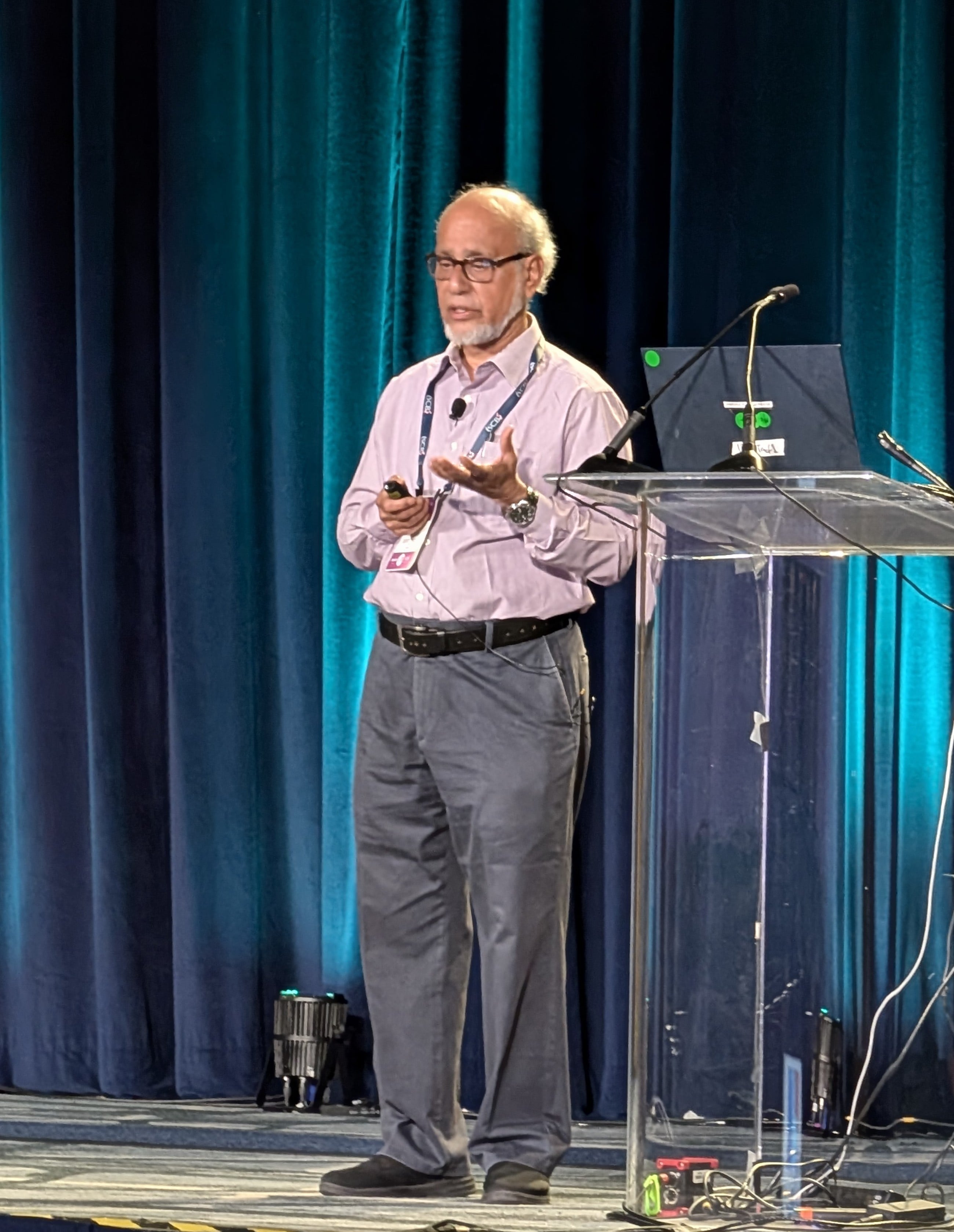
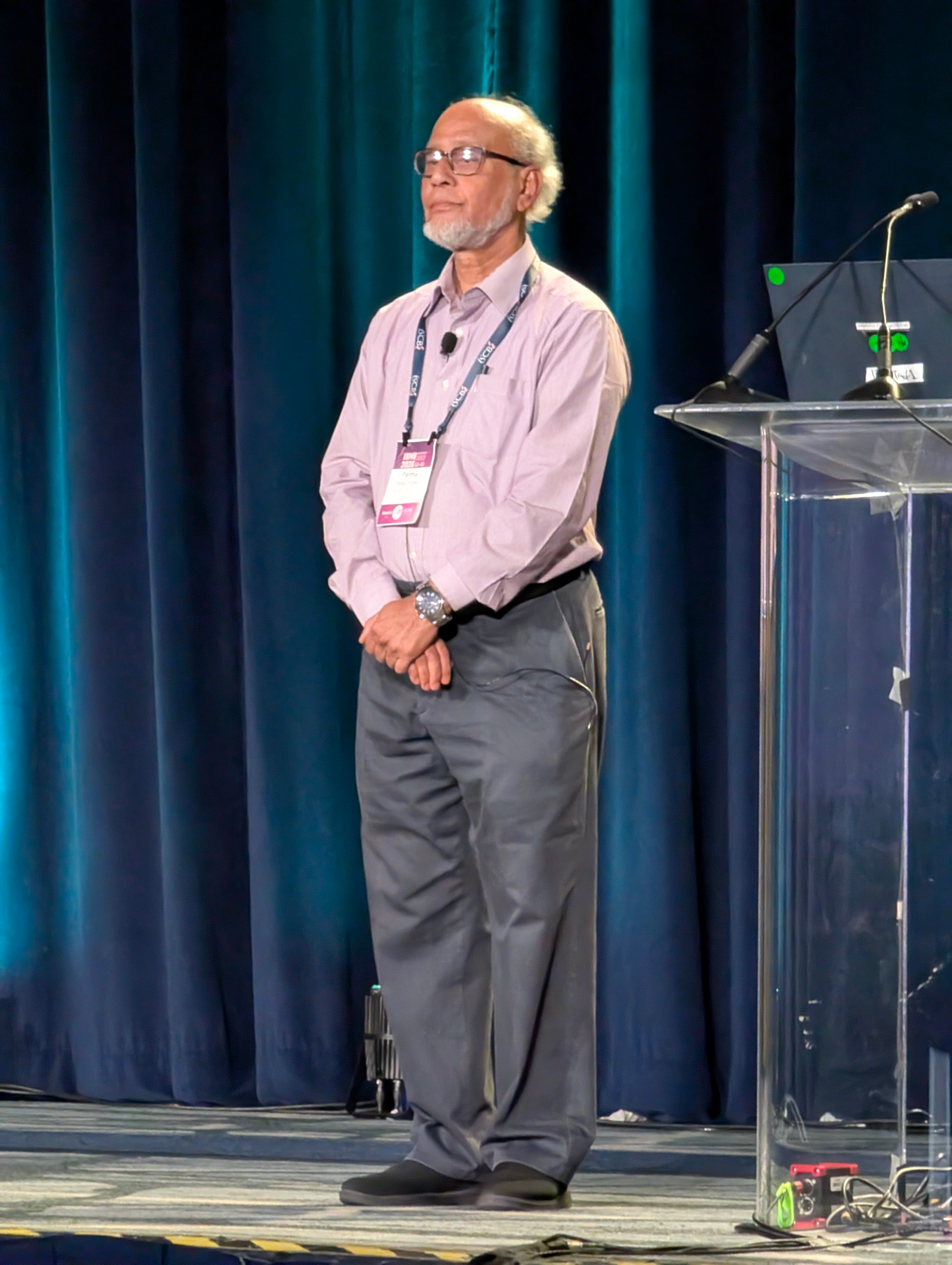
Keynote Address: Partha P. Majumder
|
|
|
|
|
In his keynote address, “Uncovering the Palimpsest of India's Population History Using Genome-Scale Analysis: Implications for Disease Epidemiology," Partha Majumder framed his talk around the image of a palimpsest: a manuscript where new writing layers over earlier text that was never fully erased. He argued that human population history works the same way, with genome-scale data now allowing researchers to recover much of that effaced earlier writing.
He opened with India's central place in human evolutionary history, noting that one of the first major waves of migration out of Africa entered the Indian subcontinent. He introduced coalescent theory as the framework for this work, describing how present-day individuals trace back through shrinking sets of common ancestors to a most recent common ancestor, with mutations accumulating along the genealogical tree to produce the polymorphic sites we observe today, under simplifying assumptions like no recombination, no selection, and random mating.
From there, he turned to the human encounter with Neanderthals and Denisovans, describing their shared ancestor in Africa more than half a million years ago, their spread across Eurasia, and their eventual disappearance around 40,000 years ago as modern humans expanded. Interbreeding left Neanderthal and Denisovan ancestry at roughly 1 to 2 percent in non-African genomes, rising to as much as 7 percent in Melanesian populations, with some evidence pointing to an additional, unidentified archaic hominin in the data.
Majumder then described India's population structure: roughly 450 tribal groups, 4,000 caste groups, and 150 religious and migrant groups, largely endogamous and spanning four major linguistic families. Sampling 42 populations, his group found tribal groups more genomically differentiated than caste groups, reflecting older origins, with island populations like the Jarawa and Onge distinct from the mainland. Focusing on 18 mainland populations, principal components analysis revealed deep substructure, pointing to four ancestral groups: Indo-European, Dravidian, Austro-Asiatic, and Tibeto-Burman. He also touched on the Neolithic spread of agriculture, noting evidence that it spread partly through migration out of the Fertile Crescent, alongside some indication that it arose independently elsewhere too.
He closed by linking this population history to disease epidemiology, citing novel cancer-predisposing variants identified through the GenomeAsia dataset that had been missed in studies focused on predominantly Caucasian populations, along with population-specific estimates of adverse drug reaction risk derived from allele frequencies of known response-related variants. He closed by returning to the palimpsest metaphor, framing genome-scale analysis as a way of recovering the layers of India's evolutionary story.
|
|
|
|
|
BOSC
Dr. Eric Green started off Day 2 of BOSC with a keynote that focused on the realization of genomic medicine. He was one of the drivers of the Human Genome Project, pursued a lengthy and successful career in public service at the NIH, and now, as Illumina’s Chief Medical Officer, he leads its efforts to advance the clinical application of genomics, expand access to precision medicine, and increase diversity in genomic data.
In his talk, From the Human Genome Project to the Realization of Genomic Medicine: A Scientific, Medical, and Societal Journey, Dr. Green shared his perspective on the staggering evolution from the billion-dollar Human Genome Project to today’s reality – generating a human sequence in seconds for under $1,000. Still, generating data is only the first step, because our true challenge still lies in making it clinically computable.
Dr. Green highlighted the evolution of genomics from a single reference genome to a diverse map of over one billion variants. Today, genomic medicine actively saves lives, especially in ICUs, and has identified genes for over 6,000 rare diseases. The field now encompasses five core clinical pillars and is rapidly expanding into multi-omics and disease prevention. Dr. Green stressed that while genomics has officially arrived at healthcare's “adult table” – in other words, it has officially reached mainstream healthcare – we still face tremendous hurdles regarding health equity, privacy, and literacy. Overcoming these challenges requires aggressive advocacy for robust data principles to ensure equitable precision medicine for everyone.
The day’s second session covered topics close to our BOSC community’s hearts: open-source analysis tools and platforms. Talk topics covered new computational methods for sequence and omics analysis, open-source platforms and AI-enabled ecosystems for biological data, and strategies for integrating and harmonizing data across modalities, tissues, and institutions.
After lunch, there was a session on FAIR Data & Governance covering a range of topics, including open platforms for FAIR, AI-ready research data, and the governance, consent, and licensing frameworks that enable the responsible sharing of sensitive human data.
The next session focused on AI, with talks that explored what AI can and can't yet do for bioinformatics: for example, how LLMs can accelerate work like drafting data management plans, updating training materials, and cleaning up metadata; and where AI still falls short and needs human oversight. A final theme was how AI is reshaping open-science culture.
BOSC 2026 ended with a panel on Open Source in the Age of AI, moderated by Jason Williams of Cold Spring Harbor Laboratory, with panelists Alex Bateman (EMBL-EBI), Nahid Zeinali (California Medical Innovations Institute), Aida Miro-Herrans (Bioinformatics Librarian, University of Florida), and Eric Green (Illumina). The panel covered questions including “Do you feel generative AI is more of a threat or an advantage for open-source bioinformatics?” (the panelists’ views spread across both) and “Open source has traditionally rewarded reuse, contribution, transparency, and community trust. Which of those values is most challenged by AI-generated code?” (all of them, but particularly reuse and trust).
The audience asked the panel some thought-provoking questions. One person asked, “If OpenAI or Anthropic were in the room with us, what would you ask them?” (“a confidence rating on the outputs” was one answer). Another asked how the panelists felt about the rise of co-scientists. Speaking from a clinical perspective, one panelist pointed out that it’s dangerous to rely on AI-generated answers when the wrong information could potentially kill a patient. Another noted that AI models have a lot of knowledge, but it’s fairly shallow, which is abundantly clear when you're an expert in the specific scientific field.
Eventually, an audience member asked the “elephant in the room” question: is there still a need for open source when AI can just rewrite everything from scratch? One panelist pointed out that without open-source analysis tools, reproducibility would be a challenge. Another pointed out the inequity angle: some people literally can’t afford to pay for AI. And, of course, there are climate and conservation issues associated with the high energy and water use of AI – though one panelist sardonically commented that he used to lie awake at night worrying that climate change will end life as we know it, but now he feels it’s much more likely AI will kill us than global warming.
A final question fielded by the panel was, “Would you ever make an AI version of yourself?” “One of me is enough,” quipped Alex Bateman.
BOSC Chair Nomi Harris ended the day with closing remarks, thanking all the people who helped make BOSC possible. We look forward to another great meeting in Copenhagen in ‘27!
|
|
|
|
|
CAMDA
The first day of CAMDA 2026 opened with a welcome from Paweł P. Łabaj, who introduced the conference, reflected on the history of CAMDA, and presented this year's data challenges. The opening keynote was delivered by Katherine S. Pollard, who discussed how strain-resolved metagenomics combined with artificial intelligence is transforming microbiome research. She highlighted recent advances in linking microbial genes with human traits at biobank scale, while addressing the computational challenges of analyzing microbial communities at strain-level resolution.
The scientific sessions began with presentations focused on the Gut Microbiome Interaction Network Challenge. One of the presented approaches integrated microbiome data from multiple studies using differential connectivity analysis, demonstrating that network-based features significantly improve disease prediction compared to standard clinical metadata. Several other contributions explored complementary perspectives on microbiome analysis, including metabolic pathways as ecological niches, dual-layer network models integrating host and microbial interactions, knowledge graph-based interpretation of microbiome data, network-based optimal transport methods for tracking microbiome remodeling in colorectal cancer, metabolite-centric functional annotation, and ALPAR, a new tool for rapid prediction of antimicrobial resistance from bacterial genomes.
The afternoon session continued with presentations showcasing the application of machine learning to antimicrobial resistance prediction and protein representation learning. BIOTIA-DX Resistance demonstrated accurate prediction of antimicrobial resistance directly from bacterial sequencing data using curated datasets and k-mer based feature engineering. In a closing talk, R. Prabakaran from BrombergLab introduced a framework for quantifying uncertainty in protein language model embeddings, enabling researchers to identify poorly represented proteins before downstream analyses and improving the reliability of protein-based predictive models.
Overall, the first day of CAMDA 2026 highlighted the growing impact of machine learning, network biology, and integrative computational approaches in microbiome research, antimicrobial resistance, and functional genomics, while fostering engaging discussions around this year's data challenges.
|
|
|
|
|
EvolCompGen
The EvolCompGen track started off with a great keynote presentation on comparative genomics in the open ocean. Keynote speaker Casey Dunn raised the question of diversity within and across species and discussed the problem of assessment of phenotypic diversity versus species delimitation in the open ocean. Various aspects of this question were explored in over the course of the day.
Several presentations explored the impact of incomplete sorting of ancestral genetic variation in phylogenetics and considered the problem of characterizing phylogenetic heterogeneity due to incomplete lineage sorting versus other processes. A number presentations probled forces influencing phylogeny reconstruction, including the choice of input sequences, tree shape, and the impact of model and outgroup choice on root of the animal tree. The audience was startled by an in-depth comparative analysis of phylogeny inference methods that concluded that maximum likelihood estimation often results in an inferior tree. This sparked much interest and the COSI decided to discuss these results further in a panel discussion in the final session on Thursday.
Pan genomes are a representation of diversity in gene content and order in populations. Approaches for inferring ancestral pan genomes were discussed.
Diversity in sequence composition was also explored in this session. Several presentations considered methods for characterizing patterns in sequences and what those patterns can tell us about microbial and host populations, with applications to infectious disease. Nice improvements with respect to computational speed and accuracy were reported for tasks such as distance estimation and inferring population structure.
|
|
|
|
|
NetBio
The final day of the NetBio COSI highlighted how advances in AI, spatial biology, and network integration are transforming our ability to model complex biological systems.
The morning began with an outstanding keynote from Helder Nakaya, who demonstrated how integrating spatial transcriptomics with network biology reveals how tissue architecture shapes health and disease. He showcased methods that leverage spatial relationships to infer cell-cell communication and gene networks, highlighting the need for effective visualization and data reduction tools. Yurui Li extended this theme with a framework for inferring cell-specific gene regulatory networks from spatial transcriptomics data.
Several talks emphasized rigorous evaluation of network methods. Johannes Kersting presented a benchmarking pipeline for disease module discovery, while Kimberly Glass compared competing approaches for single-sample network inference.
Throughout the afternoon, speakers showcased the power of heterogeneous networks and knowledge graphs for biomedical discovery. Sang-Pil Cho, Gowri Nayar, Marzieh Ayati, Suman Pandey, and Yoshitaka Inoue presented graph learning approaches for cancer driver prediction, protein embeddings, phosphatase-substrate prediction, drug repurposing, and drug response. Fengge Chang and Iker Núñez Carpintero applied network methods to opioid biology and rare neuromuscular disease, while Deanne Taylor highlighted the NIH Common Fund Data Ecosystem Knowledge Graph. Sakina Amin, Aydin Wells, and Akshaya Rajaraman rounded out the session with network methods for immune repertoire analysis, protein structure classification, and context-specific protein complex mapping.
The day concluded with an inspiring keynote from Qian Cong, who showed how combining massive genomic datasets with state-of-the-art AI enables high-confidence prediction of protein-protein interactions and accelerates therapeutic discovery. Her talk reminded us that the most impactful AI-driven advances are still driven by deep biological expertise and human intuition.
Several NetBio attendees capped the day at the Social Networking for Network Biologists event, proving that not all meaningful network edges are found in biological data. 🤝
Thank you to all speakers, attendees, and organizers for a fantastic 2026 NetBio COSI Track!
|
|
|
|
|
TransMed
The Translational Medicine (TransMed) COSI celebrated its 11 th year with an exciting day of talks and posters.
The TransMed community have been using AI agents to assist with science and discovery. In his opening keynote, Kuan-lin Huang shared three models of using AI agents in research: making software better, scaling up customized analyses, and on the near horizon, emerging success using AI co-scientists. Later in the day, Maaly Nassar shared her work on developing the MutaPalladis platform, a suite of agents specializing in the tools needed to interpret genetic variants with particular focus on congenital diseases.
Steven Brenner presented the results of the CAGI 7 challenge to predict variants associated with stability of the ARSA protein associated with Metachromatic leukodystrophy (MLD). While AlphaMissense was last year’s champion on a related task, new methods handily outperformed it this year.
Motivated by their experience adapting to the US diet, Magdalena Nikolova and Hristo Denev designed their GutFeel research platform to integrate data from wearables and mobile-collected data to characterize post-prandial responses.
The transition from acute kidney injury to chronic kidney disease was the target of Mengying (Summer) Xia’s presentation today. She walked us through a thorough, single-cell dissection of fibroblast heterogeneity and temporal dynamics in three murine models of kidney injury.
Multimodal data integration for translational medicine was a major theme as well. Yurui Chen presented PORTALS, which extends tabular foundation models to survival modeling, integrating both proteomic and clinical features to improve state of the art ALS survival prediction. Rachel Melamed described BRONTE, an integrative neural network approach to integrate GTEX and the Allen Brain Atlas, to address the challenge that the brain tissues with available gene expression data are described at a coarser level than the detailed regions in which neurodegenerative diseases are understood to originate. Roberto Bonelli shared a multi-omic foray into building predictive models of aging in 17 eye tissues from retinal images and other eye measurement data. The study was also able to identify circulating proteomics features associated with eye aging. Another theme was fairness and generalizability. Devanshi Pratiher shared work to validate the PREDICT Breast survival calculator in the diverse Cedars-Sinai Cancer Registry, and found that while it generalizes well, there are racial disparities in calibration and genomic testing access. Yang Dai gave a complementary talk about her group’s FIG method for identifying and mitigating bias-driven variables.
The TransMed community is also continuing to develop methods for making the most of EHR data. Chenlian (Tom) Fu shared key design features of the SPARC model: patient-specific set points and modeling numbers of repeated events, such as chemotherapy cycles. Jennifer Wilson integrated prescription records in EHR with protein-protein network analysis to discover new molecular targets and drug interactions. Sonja Kleper described the use of patient histories to perform drug-wide association studies of cancer, with insights into mitigating and identifying confounding biases in these analyses.
The opportunities offered by massive clinical cohorts was made clear by many of today’s talks. Harshit Sahay’s presentation explained how he and his co-authors leveraged off-target reads from clinical sequencing data to construct a pan-cancer map of alternative lengthening of telomeres across 80+ cancers.
We finished the day with a keynote from Hoifung Poon of Microsoft Research. If we can unlock the utility of EHR with massive deep learning models, we can potentially enjoy a "free lunch" of population-scale clinical trial simulation and to learn the language of patient histories to implement digital twins. He shared exciting strategies like using text as an interlingua to bridge data modalities.
The TransMed organizers are grateful to our speakers and poster presenters for a successful day! Please visit the COSI’s posters today.
|
|
|
|
🧭Career Compass Featured Jobs🧭
|
|
|
|
|
Director, Agri-food & Natural Resources
Genome Canada
Ottawa, Ontario, Canada
Job description:
Helping Shape Canada’s Genomics Mission-Driven Impact
Genome Canada is seeking a Mission Director, Agri-food & Natural Resources to play a leadership role in shaping and stewarding mission-driven priorities that support a healthier, more sustainable, inclusive, and prosperous Canada.
The Mission Director leads the coordination and advancement of these priorities across agriculture and food systems, natural resources, and related areas, in alignment with the organization’s mandate and strategic objectives.
This role offers a unique opportunity to work at the intersection of science, policy, partnerships, and strategy, helping align people, partners, and investments so the broader system delivers impact none of us could achieve alone.
Genome Canada’s Mission Directors translate Genome Canada’s priorities into clear missions that mobilize programs, partnerships, data, and investments across the Canadian genomics ecosystem. Mission Directors provide leadership through influence, aligning functions, Genome Centres, and external partners to support effective mission execution and impact.
|
|
|
|
|
Postdoctoral Associate
Duke University, Department of Biostatistics and Bioinformatics
Durham, North Caroline, USA
Job description:
The Department of Biostatistics & Bioinformatics (B&B) at the Duke University School of Medicine engages in methodological and collaborative research, providing international and regional leadership in biostatistics, genomics, biomedical informatics, artificial intelligence and health data science. We are recruiting a creative, rigorous Postdoctoral Research Scientist in Dr. Wenpin Hou’s team to design and deploy new methods on large-scale datasets (e.g., NIH-funded and consortia resources). Dr. Wenpin Hou develops AI and statistical methods to decode gene regulatory programs from large-scale single-cell and spatial multiomics data. Her research aims to characterize developmental processes, uncover regulatory alterations in complex human diseases, and identify actionable targets for therapeutic intervention. Dr. Hou collaborate across Duke University, Columbia University, UC Santa Cruz, and Johns Hopkins to advance understanding of gene regulation, cellular mechanisms, and human health. Dr. Hou’s group has designated access to high-performance computing (H100 and H200 GPUs).
|
|
|
|
|
POSTERS
All posters must be taken down by 6pm tomorrow, Thursday, July 16.
LUGGAGE AND COAT ROOM
If you’re leaving right after the conference and checking out of your hotel room at the Washington Hilton, you can ask for your luggage to be stored during the day at the bell station on the lobby level.
If you're not staying at the Washington Hilton and need to bring your luggage with you, you will be able to store it in Conference Room 4. Simply ask at the registration desk and someone can point you in the direction of this room. Neither ISCB staff, ISMB event crew, nor the Washington Hilton staff will be responsible for your luggage.
NOTE: Conference Room 4 will be closed and locked at 6:30pm on Thursday, July 16. If you do not collect your luggage by this time, anything left in the room will be moved to the registration desk or given to lost and found.
LOST ITEMS
If you’ve lost something while attending sessions during the conference, please visit the ISMB registration desk to see if your item has been dropped off there. If your item isn't at the registration desk, please check with the hotel security or ask for any lost and found items at the hotel's reception desk.
TRANSPORTATION TO THE AIRPORT
Transportation to the airport after the conference will not be provided. However, numerous options are available from the Washington Hilton:
Rideshare and Taxis: Uber, Lyft, and taxis are readily available from the hotel. Consider using the Uber or Lyft 'Share' option to lower costs, or connect with other conference attendees to split the fare.
Metro: The Washington Hilton is near several Metro stations. You can reach all three airports by Metro:
- Reagan National (DCA): Blue and Yellow lines
- Dulles (IAD): Silver Line
- BWI: Take Metro to Union Station, then Amtrak or MARC train (about 45 minutes total)
|
|
|
|
Happening Today: Thursday, July 16
|
|
|
|
- Today's sessions:
- 10:00am – Caffeinate and Connect with Posters and Exhibitors
- 1:00pm – Lunch
- Click here for the ISMB 2026 Dining Guide
- 4:40pm – Day 5 Keynote: Marinka Zitnik (ISCB 2026 Overton Prize winner), and closing ceremonies
|
|
|
|
|