|
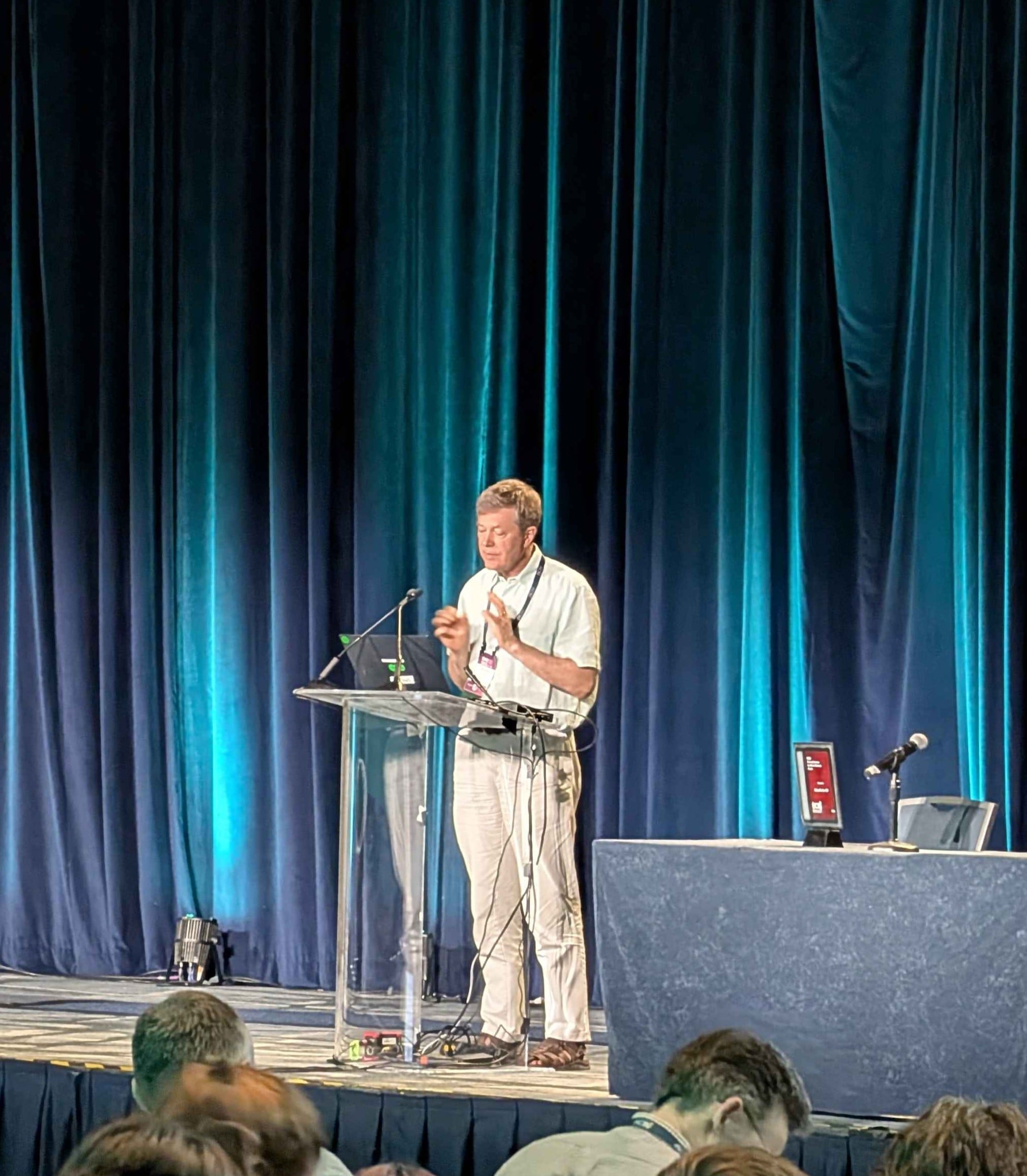
Richard Durbin, the ISCB 2026 Accomplishments by a Senior Scientist Award winner, began his keynote address by situating the field within what he called the continuing era of genome sequencing, tracing three phases: reference genomes for key organisms, population-scale resequencing and genomic assays, and now ab initio sequencing of arbitrary genomes using long-read single-molecule technology. He noted that sequencing data has grown at more than twofold per year for three decades, a pace that outstrips Moore's Law and has demanded continual innovation in computational methods.
That innovation, he argued, has repeatedly come from one source: the Burrows-Wheeler transform (BWT), introduced in 1994 for text compression and paired in 2000 with Ferragina and Manzini's FM-index for efficient search. He traced how this pairing has been reinvented for genomics again and again. BWA, developed with Heng Li, used it to solve short-read mapping at a time when even early sequencing investors doubted the task was feasible. SGA applied the same structure to genome assembly, finding overlaps between reads to build string graphs.
From there, Durbin traced the BWT's extension into haplotype analysis. The Positional Burrows-Wheeler Transform (PBWT) restructured the approach around columns of haplotype data, enabling fast matching and strong compression, and now underlies most modern genotype imputation methods. The Graph Burrows-Wheeler Transform (GBWT) extended this to pangenome graphs, storing and searching paths across thousands to hundreds of thousands of genomes, with applications in tools like Giraffe and in long-range imputation and phasing.
The most recent development he described, syng, applies the GBWT to graphs built from syncmers over a sparse de Bruijn graph. Because the early implementation's core operations scaled linearly, his group introduced a dynamic GBWT framework based on doubly-linked skip lists, enabling logarithmic-time insertion and matching.
Durbin observed that algorithmic advances have had to keep pace with genomic data generation, and that pressure shows no sign of easing. The BWT and related structures, he suggested, have proven unusually durable as a foundation for that ongoing work.
|