|
Monday, July 13: ISMB Day 2
Highlights and Recap
|
|
|
|
|
Day 2 of ISMB 2026 started off yesterday with a slideshow to commemorate and celebrate the lives of community members that we've lost over the past year. Their discoveries in and contributions to computational biology and bioinformatics have been invaluable to the work so many of us do, and will continue to help the field grow and move forward.
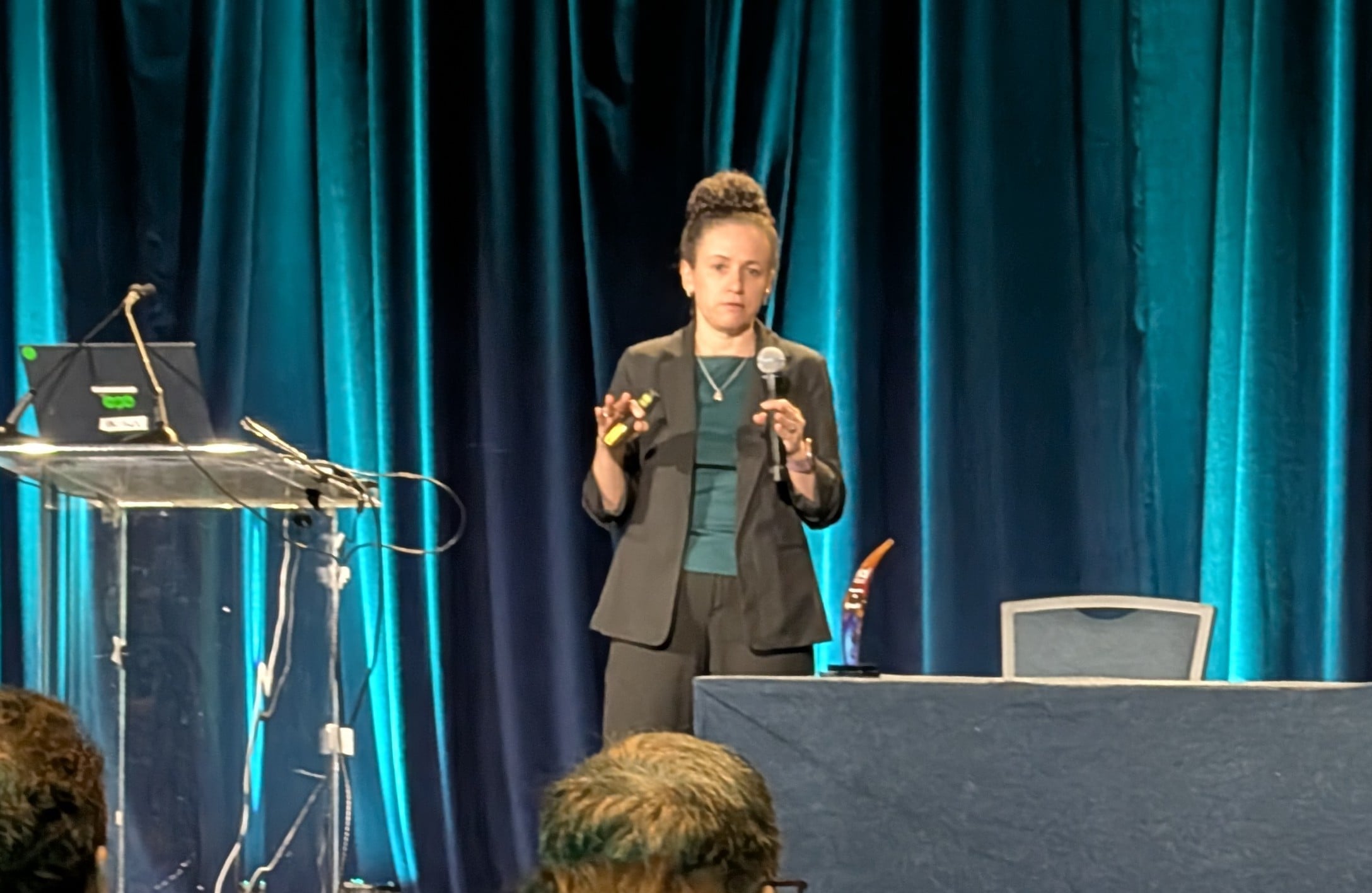
Following the memorial moment, Dr. Olga Troyanska gave her keynote address, and Day 2 of ISMB started in earnest with a full day of scientific sessions!
Read on for the highlights of the second day of the conference!
|
|
|
Keynote Address: Olga Troyanskaya
|
|
|
|
|
Olga Troyanskaya, the 2026 ISCB Innovator Award winner , opened day 2 of ISMB by arguing that biomedicine needs purpose-built, context-aware models to capture what current approaches miss: hidden disease subtypes, unseen mechanisms, unknown context, and missing variables. Her group's goal is to model disease complexity using genetically aware, cell type and tissue specific, and dynamic models, built with next-generation AI approaches spanning genome interpretation, perturbation-aware network models, and agentic AI research assistants.
She began with genome interpretation, describing models that predict the biochemical and molecular effects of variants, including noncoding mutations, to better connect mutations to clinical outcomes. Her group's Volaria framework generates gene-centered embeddings that capture the effects of both coding and noncoding variants for every gene, producing a patient-level matrix of variant effects. These embeddings have been used to predict disease progression and outcomes in chronic kidney disease, including risk of kidney failure, and to study developmental stage specific variant effects in autism, where affected children show more disruptive noncoding variants than their unaffected siblings.
Troyanskaya also discussed a multi-modal, tissue-aware graph neural network approach for in silico genetics, which embeds genes in the context of cell type specific interaction networks to predict how mutations and perturbations propagate and to identify affected mechanisms. As an example, she showed that a simulated knockout of the CFTR gene surfaced pathway effects consistent with cystic fibrosis symptoms, including ion transport dysfunction, weak epithelial barriers, and secretory and reproductive tissue effects.
Turning to autism, she described work decomposing its clinical and biological heterogeneity using SPARK cohort data and mixture modeling, replicated in an independent cohort. This uncovered phenotypically, clinically, and biologically distinct autism subclasses, ranging from broadly impacted to moderate challenges, each aligning with clinical diagnosis and linked to distinct genetic pathways and developmental timing, including differences in when disrupted genes are active before or after birth.
She closed by pointing to the next frontier: combining these multi-scale models with verifiable, agentic AI systems that can reason over biological evidence, support hypothesis generation and testing, and enable transparent, reproducible discovery, alongside a broader push to democratize these models for the field.
|
|
|
|
Wikipedia Competition Winners Announced!
|
|
|
|
|
Before our keynote this morning, the winners of the 2026 Wikipedia Competition were announced by Dan DeBlasio! The competition had both an International and Non-English Track. Winners receive a cash prize and a one-year complimentary ISCB membership.
International Track Winners
First place: k-means clustering
- Ethan Eisnaugle, Ethan Maher, Patrick Macconnell, and Jared Corbett
Second place: National Center for Biotechnology Information
- Lucas Fernandes, Luke Oleksiak, Barrett Kirumira, Roque Loza, and Delonte Roberts
Third place: Minimum Evolution
- Viet Vu, Jade O'Shaghnessy, Chase Morris, Wolfgang White, Arjun Bhatia, and Connor Dagget
Non-English Track Winners
First place: Italian: Trascrittomica spaziale
Second place: Spanish: Predicción de la función de las proteínas
- Miguel Ángel Duarte, Argüello y María Fernanda, Mosqueda Solis, and ITESI Irapuato
Third place: Spanish: Galaxy (Biología computacional)
- Mariana Amaro
- Camilo RSG Mx
|
|
|
|
|
CompMS
The CompMS COSI kicked off the first day of the ISMB 2026 conference covering the breadth of computational mass spectrometry, proteomics, metabolomics, and the infrastructure that ties them together. Across roughly a dozen oral presentations, speakers ranged from signaling-network modeling to file formats, de novo sequencing, and spatial multi-omics. Aleksandra Nita-Lazar (NIH/NIAID) opened with quantitative modeling of TLR4 signaling in macrophages, and made the memorable point that resisting the urge to overfit allowed their model to reveal genuinely missing biology, which her group then chased down empirically to two candidate negative regulators. Oliver Kohlbacher made the case for mzPeak, a compact, cloud-native successor to the twenty-year-old mzML format, noting that mass spec vendors are themselves acknowledging that parquet is the future. De novo sequencing got two complementary talks: George Glidden-Handgis's precursor-mass-free MiRROR and Samuel Khan's reference-prior approach that adds recall without sacrificing de novo performance. Rounding out the day were talks on proteoform inference from bottom-up data (ProteoPy), fine-tuning LLMs for spectral prediction, threshold-free prevalence filtering in metabolomics, spatial transcriptomic-metabolic integration (SHINE), the pFind+ search engine, JMod's push toward higher-order DIA multiplexing, and SPRINT-MS's clever use of compressed sensing to profile many antibodies in far fewer IP-MS runs. A genuinely wide-ranging day, and a good reminder of how much of this field's progress lives in the methods and plumbing as much as inspiration from biological questions.
|
|
|
|
|
CSI
Now in its second year, Computational and Systems Immunology (CSI) COSI started the day off with an overflowed room. The COSI ran across three sessions and centered on computational immunology at the intersection of genetics, spatial biology, and machine learning. Our first keynote speaker, Soumya Raychaudhuri, opened with a talk on fine-mapping context-specific autoimmune risk variants in autoimmune disease using single-cell eQTL mapping and a novel quad-modal CRISPR-editing assay called CRAFT-seq. This was followed by talks on interpretable machine-learning frameworks linking spatial transcriptomics of post-infarct heart tissue to altered macrophage-fibroblast crosstalk and candidate therapeutic targets, segmentation-free methods for discovering spatial tissue niches in imaging-based spatial transcriptomics, histology-to-phenotype prediction models for tumor immune microenvironments, spatial profiling of treatment-resistance archetypes in colitis, and a multimodal foundation model integrating gene expression with T-cell receptor sequence for single-cell immune profiling. The afternoon session opened with a keynote from Golnaz Vahedi on how cytokine signaling repositions a super-enhancer in 3D genome space to coordinately activate the Ets1-Fli1 locus during T-helper lineage commitment. This was followed by work on comprehensive nanobody repertoire mapping, deep-learning prediction of TCR–peptide-MHC structures to differentiate epitope-specific binding, and scalable phylogenetic inference of unmutated common ancestors in paired B-cell receptor lineages. The final afternoon session featured five talks bridging computational immunology methods and applications: mechanistic models of cytokine-driven gene regulation and time-resolved lineage tracing of B cells and tumors via TyCHE, followed by agentic AI for drug-target binding affinity screening. It closed with translational immunology talks spanning early transcriptional predictors of vaccine antibody response, a clonotype-aware model for predicting antitumor-reactive T cells and cancer detection using cfDNA. Across the day, recurring themes included single-cell and spatial multi-omics, statistical and functional genetics of autoimmune disease, three-dimensional genome architecture in immune cell fate decisions, and deep-learning/foundation-model approaches to receptor repertoire and structure prediction.
|
|
|
|
|
HiTSeq
André Kahles (ETH Zurich) opened with "From Reads to Retrieval: Petabase-Scale Sequence Search with MetaGraph,"presenting the MetaGraph framework (recently published in Nature) which indexes tens of millions of DNA, RNA, and protein sequence sets using annotated de Bruijn graphs, making petabases of public sequencing data efficiently full-text searchable across all domains of life. Christopher Mason (Weill Cornell Medicine) followed with a talk on genetic and epigenetic engineering for deep space, drawing on NASA Twins Study data and his broader "500-year plan" work to describe how genome/epigenome engineering, novel sequencing technologies, and even cross-species genetic elements (e.g., from tardigrades) could help protect astronauts against radiation and other physiological stresses of long-duration spaceflight to the Moon and Mars.
Today's HiTSeq sessions centered heavily on pangenomes, k-mer indexing, and long-read applications. The day opened with two proceedings talks on scaling pangenome graph algorithms: Corentin Moumard (ENS Lyon) presented a linear-time method for computing ultrabubbles in bidirected pangenome graphs (up to 30x faster than vg), while Ahsan Sanaullah (UCF) showed a compressed-space RLBWT approach that cuts peak memory more than 12-fold on terabase-scale pangenomes like HPRC Release 2. Mao-Jan Lin (Johns Hopkins) followed with ImpuT2T, a tool that patches fragmented genome assemblies using a pangenome panel to scaffold gaps more accurately than single-reference methods.
The afternoon session focused on k-mer data structures and sequence comparison theory. Rob Patro (UMD) presented an optimized SSHash variant for faster, more cache-efficient k-mer dictionary lookups; Yaron Orenstein (Bar-Ilan) introduced "10-minimizers" and "spacers," a new constant-space minimizer class with provably lower density than random minimizers. Haonan Wu (Penn State) presented repeat-robust k-mer estimators for mutation rate calculation in repetitive sequences like centromeres, and Spencer Gibson (CMU) extended seed-chain-extend theory to account for indels, narrowing the gap between theoretical and practical aligner performance.
The later slots turned to single-cell and spatial applications: Dohun Yi (Hanyang University) presented ORION, a fast barcode/UMI correction tool for Nanopore single-cell RNA-seq that substantially improves read retention over existing tools; Anirban Chakraborty (Michigan State) introduced SpatiaXen, an interactive platform for cell-type-resolved analysis of Xenium spatial transcriptomics data, applied to brain tissue responses around implanted microelectrodes. The day closed with Chaohui Li (UC San Diego) presenting BFBArchitect, an ILP-based method using long-read data to detect and reconstruct breakage-fusion-bridge cycles in cancer genomes, distinguishing them from extrachromosomal DNA amplifications.
|
|
|
|
|
iRNA
The first day of the iRNA COSI spanned RNA biology from computational structure/sequence modeling to sequencing technology, non-coding biology, and synthetic/xeno nucleic acid chemistry as an extension of natural RNA function. Our first keynote, Lijun Zhou from the University of Pennsylvania discussed an XNA-SELEX platform for the in vitro evolution of non-natural nucleic acids with programmable binding/catalytic activity for RNA targeting and protein modulation. We
had several talks from abstracts, on ML for XNAzyme fitness modeling,
RNA structure and design, methods for RBP site detection, long-read and targeted sequencing technologies, efforts enabling lncRNA annotation expansion as well as insights into 3' splice site choice, splicing of GC-rich genes and structure prediction considering pseudouridines. Finally, we finished the day with a keynote talk by Eduardo Eyras from the Australian National University discussing the use of nanopore sequencing and their ML tool SWARM to decode mRNA modifications at single-molecule resolution, and contrasting m6A and Ψ that they find follow distinct temporal trajectories during mRNA maturation.
|
|
|
|
|
Text Mining
Today’s Text Mining COSI program highlights the rapidly expanding role of language technologies in biomedical research, spanning LLM-powered question answering, multi-agent systems, knowledge-graph reasoning, target discovery, biomedical information extraction, FAIR data infrastructure, and the evaluation of generative AI systems. The program features a keynote by Halil Kılıçoğlu, “Reading Science at Scale: AI for Biomedical Discovery and Trustworthy Knowledge,” together with contributed talks and posters presenting both new methodological advances and practical applications. The day concludes with a panel discussion, “Trustworthy Literature Agents for Biomedical Discovery: Grounding, Reproducibility, and Evaluation,” examining how increasingly capable AI systems can support scientific discovery while remaining transparent, evidence-grounded, and reliable.
|
|
|
|
|
RegSys
The RegSys session on Tuesday started with an exciting keynote by Raluca Gordan who talked about the interplay of cancer mutation establishment and TF-binding interactions. She showed new experimental evidence that a significant subset of observed somatic mutations induced by mutagenesis in cancer cells are likely the result of impaired repair due to strong binding of transcription factor to the mutated allele. Her group has designed computational models that allow to quantify the difference between affinity of the repair enzyme MutA and individual transcription factors to mutated alleles, thus being able to separate which mutations may be a result of TF-inhibited repair. She also showed that UV-radiation can lead to TF-inhibited repair. Her work now allows to explore somatic mutations from the angle of involved TF-binding to understand how cancer genomes are shaped and potentially giving rise to new therapeutic approaches for TFs highly expressed in relevant cancer subtypes.
After the keynote contributed talks from the submitted abstracts started with Lixin Ren. He introduced a new method called REGA that uses a hierarchical graph representation learning approach to quantify activity of regulatory programs by combining cis-regulatory strength and trans-regulatory strength of TF to their target genes. Benchmarking on diverse datasets showed promising results compared to baselines for expression prediction and detection of co-regulatory modules.
Alexander Aivazidis presented STORMI, a stochastic model that combines regulatory rules, environmental effects and cell stochasticity to explain single cell variation. A set of possible cell paths are captured along bifurcation points using stochastic modelling over time using scRNA-seq, scMultiome and scPerturb-seq data. Benchmarking was done using perturbed TF data evaluating changes in observed and predicted gene expression, where STORMI showed improvements over previous models for that tasks, that do not consider the dynamics of the complete single cell trajectories for example.
A proceedings talk was given by Jiayao Gu presenting miRformer, a transformer-based model for prediction of miRNA-mRNA interactions. miRformer uses mRNA and mRNA sequence windows with a dual-transformer based architecture and was tested to predict target interaction sites and effects of degradation. In-silico-mutagenesis approaches revealed importance of seed regions in making predictions. Application to degradome-seq data allowed to understand which miRNA is involved in cleavage.
From the submitted abstracts, short talk presentations got the opportunity to introduce their work in addition to their posters. Junyie Tang presented SpiderNet to analyse cell-cell communication by prediction of molecular organization and sender-receiver gene pair activity that are grouped as modules. Application to ovarian tumor micro-environmental spatial transcriptome data showed enrichment for different cancer hallmark pathways and highlighted malignant interactions. The session was concluded by Jiahui Hou, who presented work on single-cell multiome data from Alzheimer's disease (AD). By combining single-cell RNA and chromatin data from Alzheimer patients with TF- ChIP-seq data, a multitask regression problem was designed to predict cell-type pseudobulk expression extending the earlier PSIONIC framework. The work suggested cell-type specific transcription factors that affect expression contrasting non-AD versus late-onset AD samples highlighting novel regulatory mechanisms in AD.
The afternoon session started with Lei Huang, who talked about TFScope a method for learning the TF-DNA binding specificity. Using a structure-guided framework, de novo inference of DNA binding specificity is predicted from the protein sequence across many TF families. In-silico mutagenesis was able to identify positions in the binding domain that are engaged in DNA interactions underlining the accuracy of the model. An interesting application of TFScope could be to design novel TF proteins that are different in their binding likelihood for certain sequences.
A proceedings talk by Noam Shimshoviz introduced NPBIP for the prediction of binding sites of nucleic-acid binding proteins for RNA or DNA. The method is designed for proteins for which no information about binding exists. It was learned for proteins that interact with RNAs and then applied to proteins that interact with DNA. Two modules are combined, SimBind uses a protein similarity-based approach and NucProNet learns interactions based on nucleic-acid and protein sequence embedding. Benchmarking showed that NPBIP improved on a variation of simpler baseline approaches for prediction of RNA and DNA interactions.
Basheer Becerra presented a method to interpret non-coding mutations relevant for the production of fetal hemoglobin. For erythrocyte-specific enhancers of the BCL11A gene CRISPR guides tiled across these enhancers were selected for clones that impact hemoglobin formation to get a more resolved information about important regulatory regions. They built a nucleotide-specific regression model to assess variant effects, which performed similar or better than methods trained on other data. A new GATA:TAL1 activator was identified that likely regulates gamma-globin expression. Experimental investigation suggested that a more potent CRISPR-based strategy could be designed for sickle-cell disease gene therapy using the novel findings.
The last long talk in the afternoon session was by Yaron Orenstein, who presented ExoShorkie to predict nucleotide-resolution RNA-seq coverage from exogenous genome sequences in yeast. Based on the Shorkie model for the task of prediction of different RNA-seq coverage tracks in yeast samples, another prediction head for exogenous sequence was added via fine-tuning of Shorkie, forming ExoShorkie. Benchmarking on different types of exogenous sequences shows clear advantages compared to Shorkie trained on native yeast data and another previous method.
The last three talks in the session were short poster talks. Dante Bolzan presented a new model for interpreting SNVs at CpG methylation sites by introducing ModBert that jointly incorporates SNV variation frequency and methylated cytosines as an additional nucleotide in the input. ModBert was trained using masked language modelling. As prediction tasks ChIP-seq peaks or gene expression abundance were fine-tuned for applications. ModBert outperformed normal BERT models and other neuronal network architectures that did not use methylation or SNV variant information.
Luca Pinello introduced Chorus, an agentic framework for allowing researchers to use and query sequence-to-function models. Chorus currently contains Sei, Borzoi, Enformer and AlphaGenome, among others. A Python interface to all models can be used for different types of applications. An agent using plain language in Chorus can run different analysis. An illustration of this was shown asking for the effect of a SNP from dbSNP. Chorus then reported the output from many different models for the SNP. Another application was fine-mapping variants in the vicinity of a query SNP. Chorus is publicly available on the github page of the Pinello group.
Finally, Swapnil Keshari explained FIREFate for understanding regulation of cell fate decisions. FIREFate combines a number of different computational methods to study regulation, such as cell-state gene regulatory networks using MIRA, TF perturbation using CellOracle and SLIDE for identification of modules of relevant transcription factors. Comparison of FIREFate to related methods that prioritize regulatory subnetworks looked promising.
In the second keynote Jian Zhou presented his work about prediction of chromatin function from DNA sequence. He made use of single-molecule footprinting based on long-read sequencing-based chromatin accessibility detection, called Fiber-seq.
He introduced sequence-to-distribution models, for predicting the distribution of long-read captured chromatin variation just from the DNA sequence of a region. The model uses diffusion to capture the variability of individual molecules. This new type of model was used to assess how accessibility and nucleosome phasing changes once known TF binding sites are inserted into a sequence. The model was able to recapitulate opening and closing of the chromatin and which regulatory elements may affect nucleosome positioning at promoters.
Analysis of motif pairs revealed synergistic pairs that close or open the chromatin locally. Analysis of Fiber-seq data showed that often DNA methylation and accessibility is not correlated. An exception are few regions, but its unclear what is behind this observation. Another interesting application was for interpretation of nucleotide variants between pairs of regulatory elements due to the increased resolution of Fiber-seq data.
Jill Moore presented the updated catalogue of cis-regulatory elements (CREs) from the expanded ENCODE dataset across many different cell types and cell states. The expanded dataset led to over 2 million CREs in human. STARR-seq was used to investigate the regulatory potential of the CREs. In particular, this was used to characterize elements that appear to perform as silencers. A majority of those were specifically active in neuronal cell types. A few of the elements were tested in mouse enhancer assays validating the prediction approach. A number of TF motifs could be identified from this, using the detected silencing CREs. A new webtool called SCREEN enables exploration of this rich data resource.
The final talk of the day was given by Ivan Ovcharenko who talked about an application of TREDNet to predict the effect of GWAS variants. TREDNet was used to predict regulatory regions that may act as enhancers or silencers for gene expression. Based on those, they found that the enrichment of GWAS SNPs differs between enhancer or silencer regions in cell types across different diseases. He showed examples of predicted silencers that seem to be mutated in patients with Alzheimer's disease leading to upregulation of genes.
|
|
|
|
Navigating the Virtual Platform
The ISMB 2026 virtual platform is powered by Performedia!
The platform will work on any browser, but if you do experience issues, you can access the help chat for troubleshooting assistance. To do so, select "Help" from the menu bar, then click "Contact Us" and fill out the form.
You can also email [email protected].
|
|
|
Happening Today: Tuesday, July 14
|
|
|
|
|